What Is the Most Rewarding Volunteer Work? (It’s Not the Cause. It’s the Distance.)
Updated August 2026.
Short answer: The most rewarding volunteer work is the kind where you know the person you’re helping, you see the result with your own eyes, and you chose to do it rather than got assigned to it. That’s why mentoring, hospice companionship, meal delivery, and one-on-one help for a neighbor come up again and again as “the most meaningful thing I’ve ever done,” and sorting boxes in a warehouse almost never does. The cause matters less than the distance between you and the person on the other end.
- Why some volunteering feels amazing and some feels like a shift
- The most rewarding volunteer jobs, ranked
- One Saturday, one driver’s license
- The least rewarding volunteer work (and how to fix it)
- The reward that isn’t only a feeling: Merit Score
- How to find work that will feel rewarding to you
- FAQ
Why some volunteering feels amazing and some feels like a shift
Ask ten long-time volunteers about the most rewarding thing they’ve done and you’ll rarely hear “the big fundraiser” or “the Saturday at the warehouse.” You’ll hear about one kid who finally read a full page. One old man who remembered their name. One ride to a hospital.
That’s not sentimentality. Psychologists have been pulling this apart for twenty years, and the pattern is consistent. Helping feels good when three things are present.
1. A specific person, not a category. People give more, and feel more, when the beneficiary is a real, identifiable person rather than a statistic; researchers call it the identifiable victim effect. In a classic study by Adam Grant, university fundraisers who spent just five minutes talking with one student their calls had put through school raised dramatically more money over the following month than colleagues who never met anyone. Same job, same script. The only difference was a face.
2. Seeing the impact. In a set of experiments led by Lara Aknin and Elizabeth Dunn, spending on others made people happier only when they could see how it made a difference in a recipient’s life. Giving into a black box did nothing for the giver’s mood. In other words: the warehouse shift isn’t less noble. It just never shows you the ending.
3. Your own choice. Netta Weinstein and Richard Ryan ran four studies on this and found that helping boosts well-being when it’s voluntary and self-directed, and largely fails to when people feel pressured, obligated, or assigned. Mandatory service hours, guilt-driven sign-ups, and “my company makes us do this” all score low. Interestingly, the recipients in those studies also felt better when their helper was doing it freely.
Put the three together and you get a simple formula. Rewarding = a real person + a visible result + your own decision. Everything below is ranked by that formula, not by how good it sounds on a résumé.
The most rewarding volunteer jobs, ranked by that formula
1. Helping one person nearby get unstuck
This is a whole category, not one activity, and it’s the one that scores highest on all three ingredients. It comes in a few shapes:
- Bringing something to the person who needs it. A stroller, a winter coat, a bag of groceries, a laptop your kid outgrew. You drive it over, you meet them, they say thank you to your face. Easy, quick, and you skip the marketplace entirely.
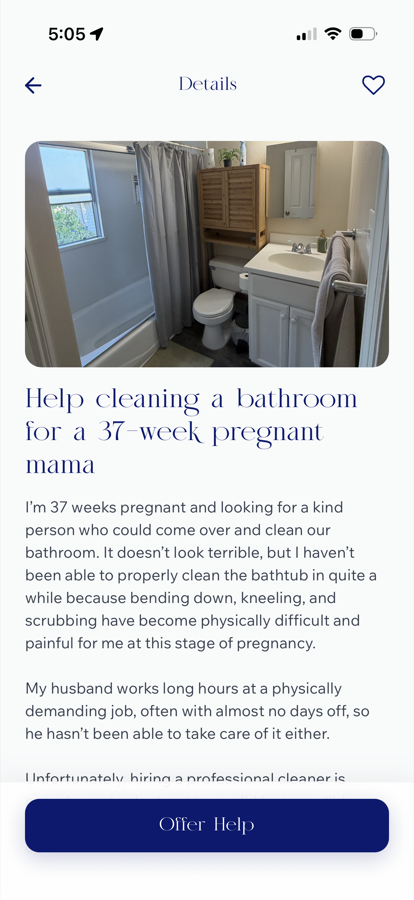
- Physical help. Moving a couch. Carrying boxes up three flights for someone who just arrived and knows no one. As I write this, one of the open requests in the Merit feed is from a woman nine months pregnant who can’t bend down anymore and needs someone to scrub her bathtub. Forty minutes of work, and she’ll remember it every day until the baby comes.
- Rides. A job interview, a doctor’s appointment, the DMV (more on that below). In most of America, no car means no life.
- A couple of hours of your presence. Watching a toddler so a single mom can go to an interview. Sitting with someone’s father while they run errands.
Here’s the giving-things version from my own life. A while ago my family passed on our baby things, including a car seat that costs a small fortune new, to a mom with a newborn who couldn’t afford any of it. I could have listed that seat on a marketplace, spent a week answering “is this still available,” haggled with three strangers, and made maybe fifty dollars. Instead I handed it to one person and watched her face. Every time she buckles her kid into that seat, she’ll think of a stranger who helped. Fifty dollars doesn’t buy that.
Every item on that list has a real person, a result you see the same day, and a decision that’s entirely yours. The catch is that none of these needs show up on any volunteer website. You have to find them, which is exactly why I built Merit: people nearby post what they need, from a car seat to a ride to the DMV, you see it, you decide.
2. Mentoring or tutoring one person, long-term
Same person, every week, for months. With a kid, you see the reading level go up and you’re in the audience at the play. Programs like Big Brothers Big Sisters have waitlists of kids because there aren’t enough adults, so you’re filling a real gap.
But mentoring isn’t only for children. An immigrant who needs someone to practice interview answers with. A friend of a friend switching careers at 45. A newcomer who doesn’t know how anything here works, from the DMV to the school system. An hour a week from someone who’s already been through it can save a person a year of wandering. Communities like Career Pathway Institute exist because that kind of mentor is so hard to find.
The catch: it only works if you actually show up every week. Miss three sessions and you’ve taught the person one more adult can’t be relied on.
3. Hospice companionship
Sitting with someone in their last months, holding a hand, giving a spouse two hours to sleep. Hospice volunteers describe it as the most profound thing they’ve done, almost without exception. Person: yes. Impact: you see it on the family’s faces. Choice: nobody does this by accident.
The catch: you’ll need training (usually 20–30 hours) and you’ll grieve. Most people find it worth it.
4. Delivering meals to homebound seniors
You’re often the only person that senior sees that day. Regular routes mean you learn names, notice when someone isn’t doing well, and become part of a life. Meals on Wheels programs across the country are short on drivers, so your absence would be felt.
The catch: it happens on weekday middays, which rules out most 9-to-5 workers.
5. Crisis and support lines
You talk one person through the worst night of their year. High on the “real person” scale, and you often hear the change in their voice by the end of the call. Lower on “visible result,” because you almost never learn what happened after.
The catch: heavy training, emotionally draining shifts, and strict rules against follow-up.
6. Fostering an animal
A frightened dog arrives, a confident dog leaves for a new home. You see the whole arc. Not a human, but the impact could not be more visible, and it’s fully your choice.
The catch: you will cry at every adoption.
7. Coaching a kids’ team or teaching a skill
Music, chess, soccer, coding, English. You watch competence appear in real time, and kids remember their coaches for life.
The catch: seasonal, and you need to actually know the thing.
8. Disaster relief
Intense, physical, and unmistakably useful. After a flood, handing someone dry clothes has no ambiguity to it.
The catch: the need is sporadic, and you have to be trained before, not after.
9. Building homes (Habitat for Humanity and similar)
Frequently listed as “the most rewarding,” and the day itself is great: you see a wall go up. But most volunteers never meet the family who moves in, so the “real person” ingredient is weaker than people expect.
10. Sorting and packing at a food bank or warehouse
The most common volunteer activity in America, and the one people most often describe as “fine.” Important work; genuinely so. But the person at the end of the line is invisible, the result is a pallet, and most people are there because a group signed them up. All three ingredients at their weakest. There’s a fix, though, and it’s in the section after next.
What it feels like from the helper’s side: one Saturday, one driver’s license
Here is the story I mentioned. A young mom, new to San Jose, with a toddler and no car of her own, posted a request on Merit: she needed someone to bring a car to the DMV so she could take her driving test. In California, a license is the first step to a job, to daycare, to a life you run yourself. She had no one to ask.
A man saw the request and answered. He had just bought a brand-new Rivian. Here’s how he described it afterward (lightly edited from his messages):
“Handing my new car to a stranger who doesn’t even have a license yet was not easy at first. Then something tipped. It’s just a car. Cars can be fixed. The chance of anything happening was tiny. On the other side of the scale was a whole human life and where it goes from here. Those two things aren’t comparable.”
“At the start she was a strange person from the internet. An hour later she was just a nice human being, the same as me, trying to find some happiness and be a good person. She stopped being a risky stranger and became a person.”
“When she came out and showed me the examiner’s sheet with ‘pass’ on it, I felt something big and important. It’s a feeling that’s so rare you almost never get it from ordinary daily life. Then later she sent a photo and a thank-you review through the app, and that was unbelievable. You can’t buy that. You don’t get it from a movie. It’s something warm and deep that’s hard to put into words.”
Three hours of his Saturday. Notice every ingredient in his account: a specific person who turned from “stranger” into “human being,” a result he could literally hold in his hand, and a decision that was entirely his.
That is what “the most rewarding volunteer work” looks like in practice. Nobody assigned it. No organization was involved. Here’s the short video, with her confirmation.
The least rewarding volunteer work (and how to fix it if you’re already doing it)
I don’t want to knock warehouse shifts or big group events. Food banks need hands, and a hundred people packing boxes on a Saturday feeds real families. The problem isn’t the work; it’s that the way it’s set up strips out all three ingredients. Here’s how to put them back:
- Ask to see the end of the line. Many food banks run distribution days where you hand the box to the family. Ask to work one of those instead of the warehouse. Same organization, completely different feeling.
- Go back to the same place. Faces become names on the third visit. One-off shifts never get there.
- Pick the shift they can’t fill. If your absence wouldn’t matter, you’re not where you’re needed. Ask what nobody wants to do, then do it.
- Bring the decision back to you. If you’re volunteering because your company, school, or guilt made you, find one thing you’d do anyway, and do that alongside it.
The reward that isn’t only a feeling: Merit Score
Everything above is about the emotional side, because that’s what “rewarding” usually means. But there’s one more kind of reward that, as far as I know, no other form of volunteering offers, and I’d be leaving something out if I didn’t mention it.
When you help someone through Merit, the person you helped confirms it, and you earn Merit Score: think of it as a kindness index attached to your name, the way a credit score is attached to your finances, except this one goes up every time you do something good for someone. Your score is visible, it’s yours, and it’s built entirely from real people saying “yes, this person showed up for me.”
And businesses are starting to decide that people with a high Merit Score deserve something back. The first is The Cycle, a women’s wellness drink sold at Sprouts and other natural grocers, which gives 20% off to kind people on Merit. We’re talking with local cafés and shops now, and the list will grow.
To be clear: nobody helps a stranger pass her driving test for a discount on a drink. That’s not the point. The point is that kindness has always been invisible and unrewarded except by the feeling itself, and Merit is one of the first places where being a good neighbor has a record you can show and a benefit you can use. With Merit, being kind is, in the most literal sense, worth it.
How to find volunteer work that will actually feel rewarding to you
Forget the cause list for a second and answer three questions:
Whose face will you see? If the answer is “no one’s,” lower your expectations or pick something else.
How will you know it worked? A reading score, a license, a signature, a text message that says “we made it.” If there’s no possible way to find out, the reward gets cut in half.
Did you choose it? Not your employer, not your school, not your sense of obligation. You.
If you want the shortest path to all three: help one person near you with one concrete thing. That’s what Merit is for. Open the app, see what someone within a few miles needs this week, and give an afternoon. It might be a ride, a couple of boxes, a driving test. You’ll know within a day whether it worked, because they’ll tell you.
Frequently asked questions
What is the best volunteering activity?
For most people, one-on-one work with the same person over time: mentoring, hospice companionship, meal delivery, or direct help for a neighbor. “Best” depends on your schedule and skills, but the activities people rank highest all share the same shape: one person, a visible result, your own choice.
What are the most rewarding volunteer jobs?
Mentoring a child, hospice volunteering, delivering meals to seniors, crisis line work, fostering animals, and informal one-on-one help for someone nearby. See the ranked list above for why, and for the catch with each.
What is the golden rule of volunteering?
Show up when you said you would, and do what’s actually needed rather than what you’d prefer to do. Organizations lose more volunteers to no-shows than to a lack of sign-ups. (We go deeper on this in Where Are Volunteers Needed the Most?)
What are the four C’s of volunteering?
The version most trainers use is Commitment, Consistency, Communication, and Compassion. Commit to something you can sustain, be consistent, communicate early when plans change, and remember there is a person on the other end of every task.
Is volunteering supposed to feel good? What if I don’t feel anything?
It usually does, and the research above explains why. If it doesn’t, that’s information, not a character flaw. Nearly always, one of the three ingredients is missing: you’re not seeing a person, you’re not seeing a result, or you didn’t really choose it. Change one of those before you conclude volunteering “isn’t for you.”
The bottom line
The most rewarding volunteer work isn’t a cause. It’s a distance. The closer you are to one real person, the more clearly you see the result, and the more the decision is your own, the more it gives back. Pick any activity on the list above and make it closer. Or skip the list, find one person near you who’s stuck, and give them three hours. You’ll remember it longer than anything you did for yourself this year.
Sources: Weinstein & Ryan (2010), “When helping helps,” Journal of Personality and Social Psychology; Aknin, Dunn, Whillans, Grant & Norton (2013), “Making a difference matters,” Journal of Economic Behavior & Organization; Grant et al. (2007), “Impact and the art of motivation maintenance,” Organizational Behavior and Human Decision Processes; Meals on Wheels America, The Urgent Need: Waitlists (2026).
About the author: Andrei Novikov is the founder of Merit, a free app that connects people who need a hand with people nearby who are willing to help. He built Merit around a simple idea: most life-changing help takes two hours, not a foundation — it just needs a way to be seen.
Merit is an app where kind people help each other — and earn real-life rewards for doing good deeds.