CSR Trends 2027: The Year Corporate Social Impact Gets Personal
Updated September 2026.
Short answer: Seven trends will define corporate social responsibility in 2027: verified impact replacing claimed impact, trust migrating from institutions to neighbors, hyperlocal programs beating global pledges, “Volunteering 2.0” replacing the annual service day, a sober and mindful consumer redefining what purpose means, brands beginning to reward individual kindness directly, and the quiet rebranding of CSR itself. Underneath all seven runs one story: societies are getting measurably lonelier and more distrustful, while a counter-current of people, led by the young, is deliberately choosing connection, health, and meaning. The brands that win 2027 will be the ones that plant themselves at that intersection. Here’s the data.
- The setup: two curves are colliding
- Trend 1: Verified impact or no impact
- Trend 2: The trust migration, from institutions to neighbors
- Trend 3: Hyperlocal beats global
- Trend 4: Volunteering 2.0
- Trend 5: The sober, mindful consumer
- Trend 6: Rewarding individual kindness
- Trend 7: CSR quietly renames itself
- FAQ
The setup: two curves are colliding
If you’re writing a 2027 social impact plan right now, you’re planning for a society that looks like this.
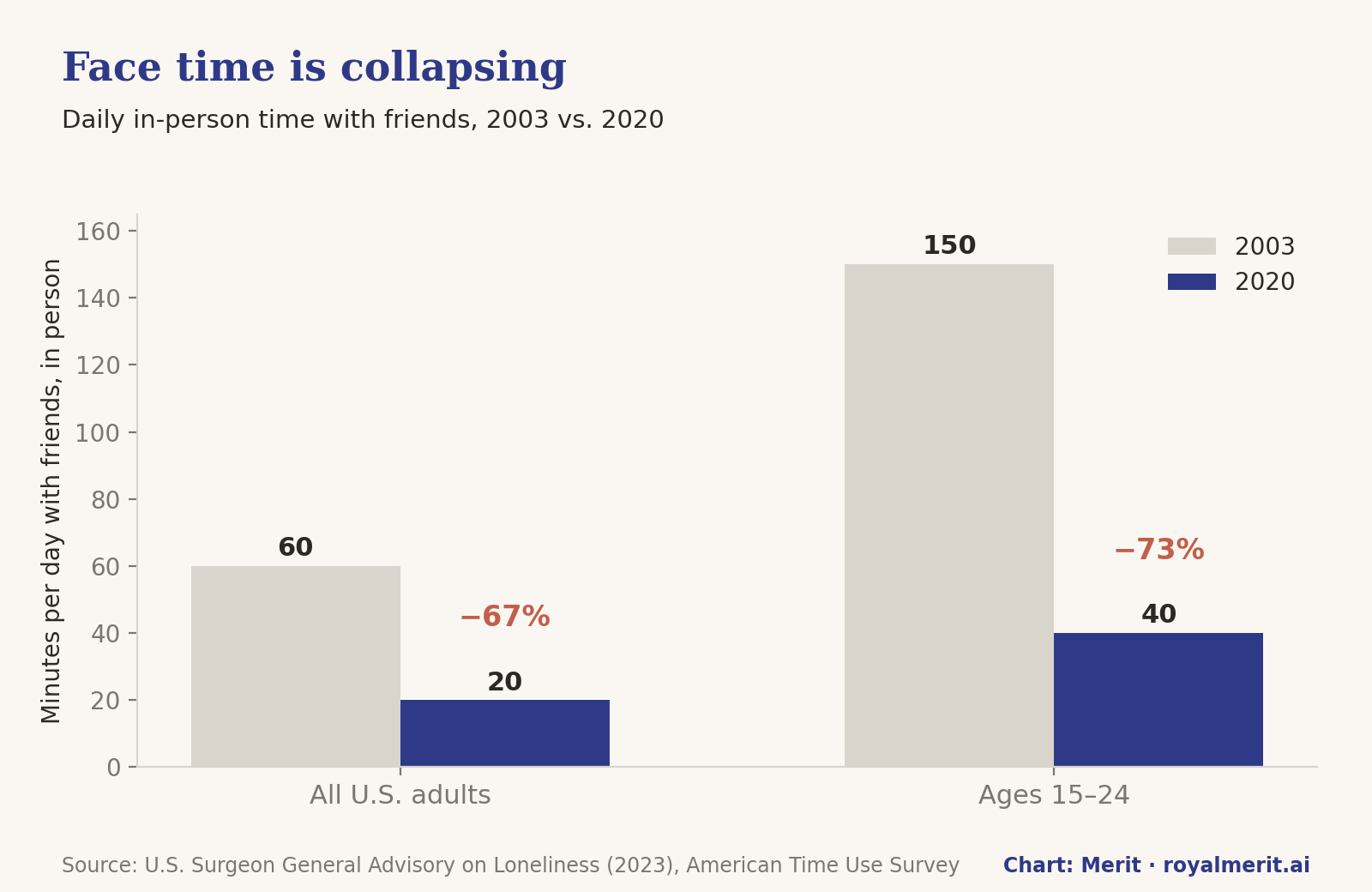
Curve one: disconnection, measured. Between 2003 and 2020, the daily time Americans spend with friends in person collapsed from 60 minutes to 20; for people aged 15-24 it fell from roughly 150 minutes a day to 40, a 73% drop (U.S. Surgeon General’s Advisory on the loneliness epidemic). About half of American adults report experiencing loneliness, with a mortality impact the Surgeon General compared to smoking 15 cigarettes a day.
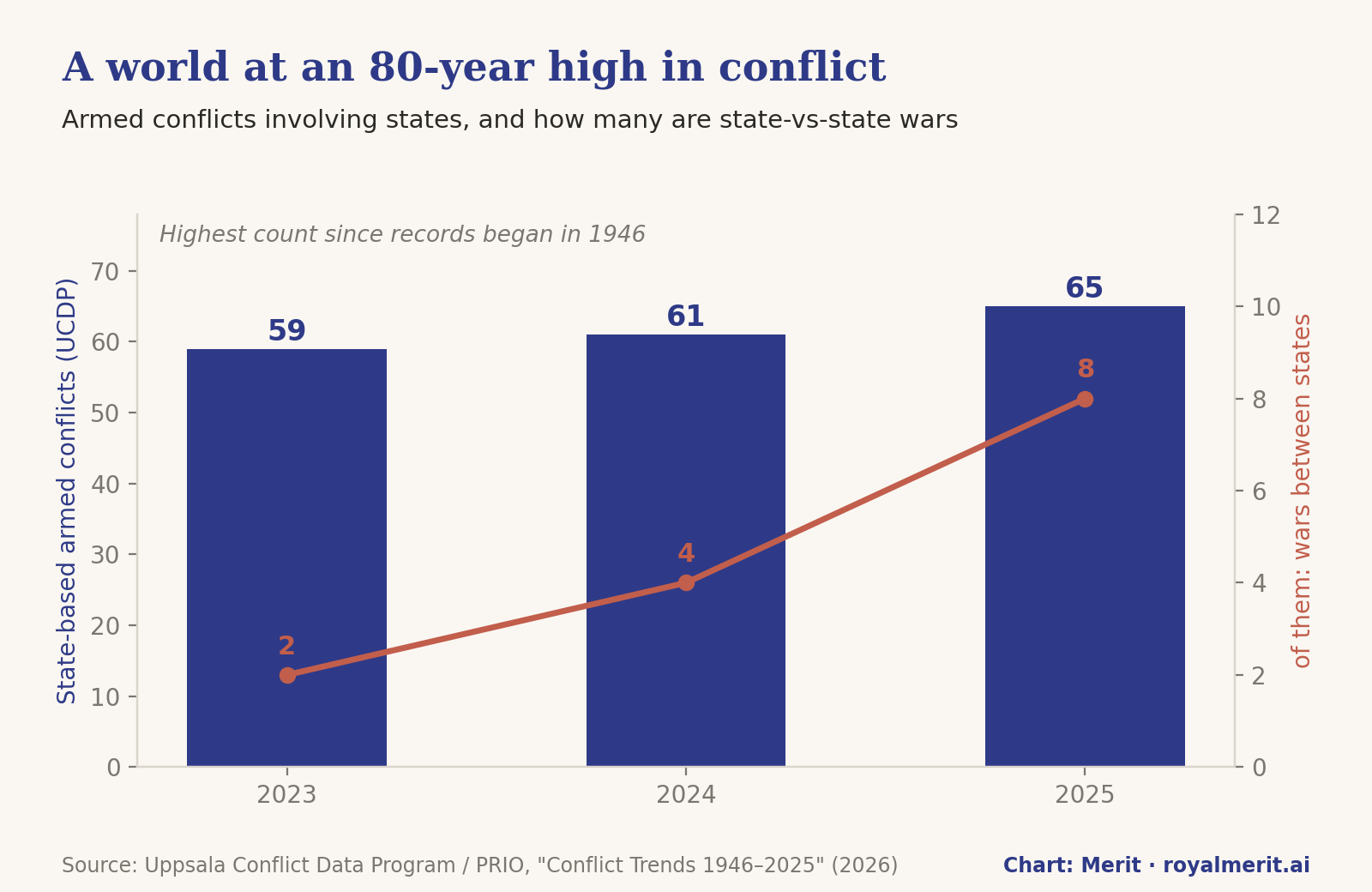
The 2026 Edelman Trust Barometer gave this era its word: insularity. Seven in ten people worldwide are now unwilling or hesitant to trust someone with different values, backgrounds, or information sources, and only 32% believe the next generation will be better off. Technology is pouring fuel on it: the share of adults who say they can no longer tell real content from AI-generated content jumped from 66% in 2025 to 85% in 2026, and in controlled tests, Americans’ ability to spot deepfakes is statistically indistinguishable from a coin flip. And at the largest scale, UCDP recorded 65 state-based armed conflicts in 2025, the highest count since records began in 1946, while the Global Peace Index deteriorated for the twelfth consecutive year.
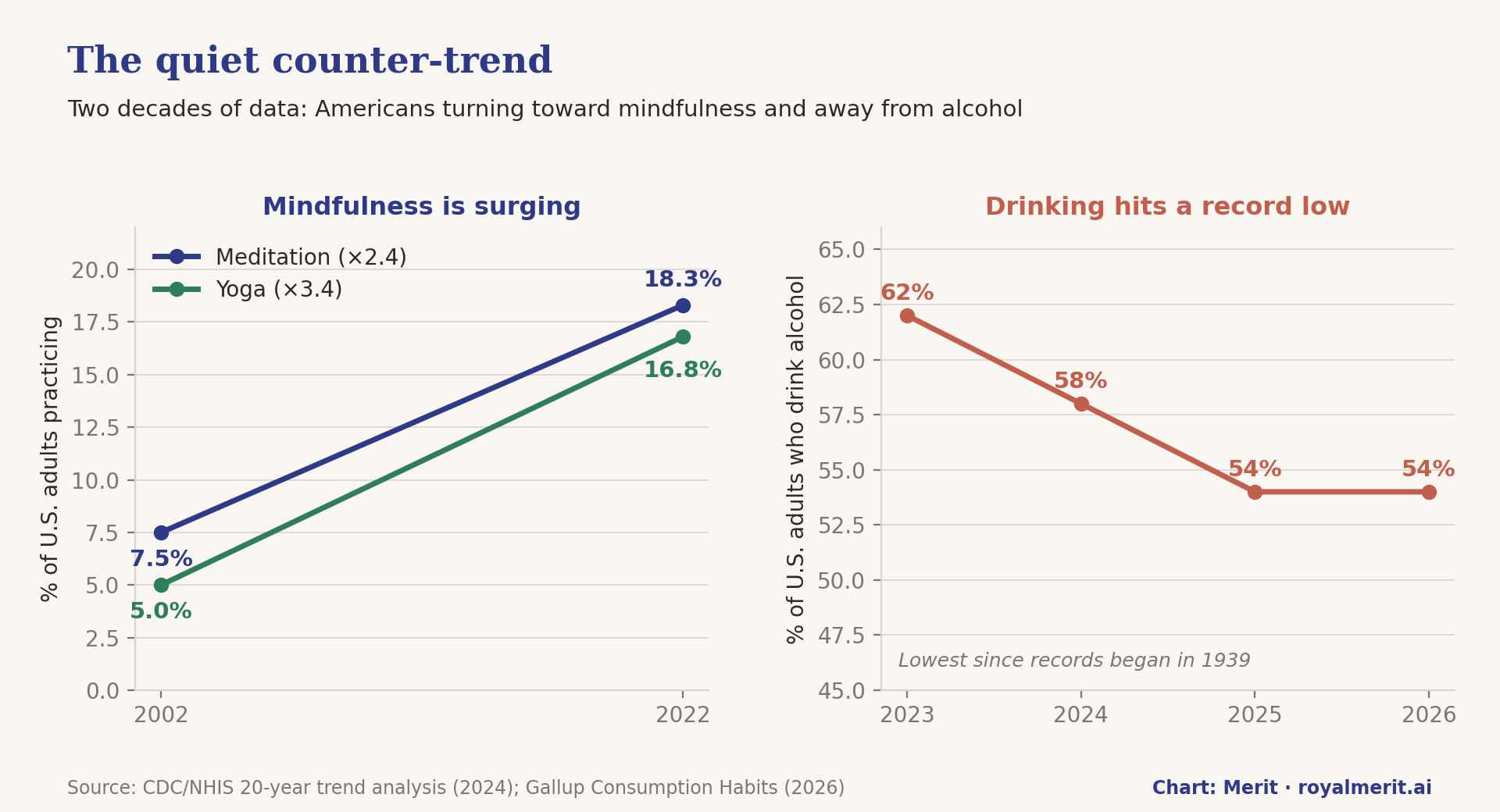
Curve two: the quiet counter-trend. The same years produced the opposite motion among individuals. The share of Americans who drink alcohol has fallen to 54%, the lowest in Gallup’s 87-year trend, with young adults dropping from 59% to 50% in three years; teen substance use sits at record lows. Meditation practice among U.S. adults grew almost 2.5-fold in twenty years, from 7.5% in 2002 to 18.3% in 2022, roughly one in five American adults, while yoga more than tripled over the same period, from 5% to 16.8%. More than 75% of Gen Z report dating-app burnout, and 79% of college students now skip the apps in favor of meeting people in person, at run clubs, book clubs, and other third places. And at work, 44% of Gen Zs and 45% of millennials have already left a job that lacked purpose.
Read the two curves together and 2027’s social impact brief writes itself: people are starving for real, local, human connection, they are done with performative everything, and a visible cohort is actively looking for a healthier way to live. Every trend below is a version of business responding to that collision.
Trend 1: Verified impact or no impact
The compliance layer everyone saw coming has arrived: assurance frameworks like the IAASB’s ISSA 5000 are making sustainability data auditable at financial grade, and vague narrative reports are dying. But the deeper driver isn’t regulation; it’s the trust environment above. In a world where 85% of people can’t tell real from fake, claimed impact is worth approximately nothing. The 2027 standard is impact that a skeptic can verify: named partners, published numbers, receipts. This cuts budgets in a healthy way: one provable program beats five press releases.
Trend 2: The trust migration, from institutions to neighbors
Here’s the full trust picture, and it has three layers, not one.
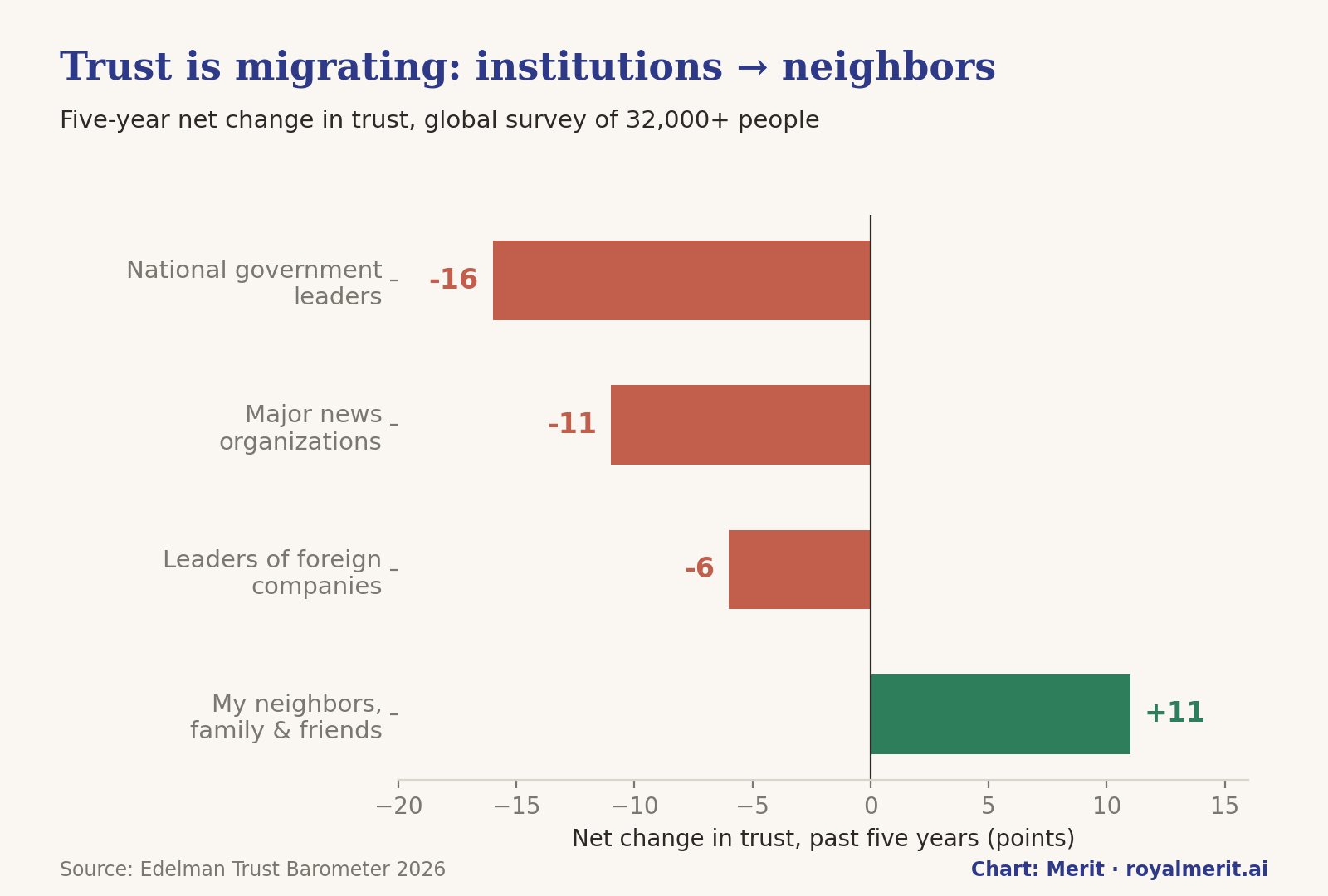
Layer one: institutions are losing trust. Over five years, national government leaders are down 16 points and major news organizations down 11 in the Edelman data. Fine, you might say; distrusting politicians and media is practically an American tradition.
Layer two: people are losing trust in people in general, too. This is the one most strategy decks miss. The share of Americans who say “most people can be trusted” has fallen from 46% in 1972 to 34% today (GSS and Pew, which found the identical 34% in 2023-24), and only about a quarter of Americans now know most of their neighbors. Add Edelman’s insularity finding, 70% unwilling or hesitant to trust someone with different values or backgrounds, and you get a society where the default setting toward a stranger is suspicion.
Layer three, and this is the twist: one category of trust is growing. In the same Edelman data where every institution falls, “my neighbors, family and friends” gained 11 points. People trust “people in general” less than ever, and “my people” more than ever. The circle of trust isn’t disappearing; it’s tightening, and everything inside it is appreciating in value.
The strategic conclusion writes itself: the highest-leverage social act of 2027 is moving someone across that boundary, from “stranger” to “my people.” And we know exactly what does that, because it happens every time one person concretely helps another. A volunteer on our platform who lent his car to a stranger for her driving test described the crossing in real time: at the start she was “a strange person from the internet,” and an hour later “she was just a nice human being, the same as me.” That conversion, repeated at scale, is the only mechanism that widens the one circle where trust still lives. Programs that route help through big, distant structures inherit layer-one distrust. Programs that put your brand inside a neighbor-helping-neighbor moment inherit layer three. The question for every 2027 initiative: does a real person experience this help from another real person, or from a logo?
Trend 3: Hyperlocal beats global
A consequence of Trend 2. Global pledges photograph well and land badly; a specific zip code changing is something people can see with their own eyes. Expect more corporate giving to name streets instead of continents: neighborhood grants, city-level partnerships, employee-chosen local causes. And hyperlocal quietly solves the measurement problem from Trend 1: when a program serves one neighborhood instead of “the planet,” the results stop being estimates and become a list, this many families, these exact outcomes, each one nameable and verifiable. Small geography, fully countable impact, which is precisely what the 2027 skeptic demands.
Trend 4: Volunteering 2.0, the end of the annual service day
Employee volunteering is being rebuilt around two facts. First, the one-off corporate service day, a hundred people in matching t-shirts photographing a park cleanup, is exactly the “performative everything” the workforce has stopped believing in. Second, 18% of American volunteers now serve fully or partially online, and the biggest volunteer force in the country isn’t formal at all: 54% of Americans help their neighbors informally versus 28% through organizations. The 2027 version is skills-based, continuous, and low-friction: an engineer mentoring one newcomer, an accountant doing one nonprofit’s books, an employee answering one neighbor’s request on a weekday evening, with the company counting and celebrating confirmed help rather than bus-trip attendance.
Trend 5: The sober, mindful consumer changes what “purpose” means
Purpose marketing was built for a consumer who wanted brands to have opinions. The consumer of 2027 is different: drinking less than any generation on record, meditating in the tens of millions, quitting apps designed to be addictive, and leaving jobs that feel meaningless. This consumer doesn’t want your opinion; they want your help living the life they’re already choosing: calmer, healthier, more connected, more real. Purpose portfolios will shift accordingly, away from slogan campaigns and toward products, perks, and programs that concretely support wellbeing and human connection. (One early example from our own partner list: The Cycle, a women’s wellness brand, chose to give its discount not to everyone, but specifically to people with a verified record of helping others.)
Trend 6: Rewarding individual kindness, the new frontier
Full disclosure: this is the trend my company lives in, so read this section as a founder’s argument, with the logic laid out for your own judgment.
Corporate giving has always rewarded organizations: a donation goes to a nonprofit, and the individual acts of kindness that actually stitch a society together, the ride to the DMV, the crib passed to a family that needs it, the two hours with an elderly neighbor, remain invisible and unrewarded. In 2027, the infrastructure to change that exists. Merit verifies person-to-person help (each act confirmed by the person helped) and turns it into a Merit Score, a kindness index attached to a real person. Businesses then attach benefits to that score: a discount, a perk, an experience, redeemable via QR or one-time codes that can’t be faked.
Why this pencils out as the asymmetric PR play of 2027: a high Merit Score is genuinely hard to earn, so few people redeem, which keeps the cost small; but the story, we reward kind people, works from day one, and it plants your brand precisely where Trend 2 says trust now lives: between neighbors. Most brands sponsor things. Very few brands stand for changing how people treat each other. That position is, for now, unoccupied.
Trend 7: CSR quietly renames itself (again)
The question “what has replaced CSR?” is now a top Google query, and the answer is: the work continues under new names. In parts of the market facing political backlash, teams are trading “ESG” vocabulary for pragmatic language: social impact, community investment, corporate citizenship, resilience. Treat this as packaging, not retreat: budgets for the underlying work are projected to keep growing through 2027. The teams that navigate 2027 best will be bilingual, rigorous enough for the auditors, human enough for the neighbors.
Frequently asked questions
What are the trends in corporate social responsibility for 2026 vs. 2027?
2026 was the year of data discipline: assurance standards, auditable metrics, quieter language. 2027 keeps all of that and adds direction: where impact happens (local, person-to-person) matters as much as how it’s measured, because that’s where trust has migrated.
What has replaced CSR?
Nothing replaced the work; the label is fragmenting into “social impact,” “corporate citizenship,” and “community investment,” partly as political camouflage and partly because “responsibility” undersells what leading companies now treat as strategy. If your stakeholders flinch at one term, use another; keep the substance.
What are the six common CSR initiatives?
The classic six: environmental sustainability, philanthropy and giving, ethical labor practices, employee volunteering, community engagement, and responsible sourcing. The 2027 reading of this list: the first and last are becoming compliance, and the middle four are being rebuilt around direct human connection.
Is ESG still relevant in 2027?
The acronym is contested; the function is not. Disclosure requirements are hardening globally, B2B buyers increasingly screen suppliers on it, and the social “S”, long the vaguest letter, is where the differentiation now is, precisely because it’s the hardest to fake.
The bottom line
Put the data in one sentence: people trust institutions less, trust strangers less, and trust the small circle of “my people” more than ever, while a visible generation is deliberately choosing health, presence, and real connection over everything performative. A 2027 social impact strategy that routes money through distant structures is swimming against both currents. One that helps real neighbors help each other, visibly and verifiably, does something rarer than charity: it moves people across the boundary from stranger to “my people,” one act of help at a time, and widens the only circle where trust is still growing. That’s the position we built Merit to offer brands, and whether or not you ever work with us, it’s the position we’d urge you to claim in 2027: not another sponsor, but the brand that made kindness pay.
These charts are free to reuse with attribution (Chart: Merit, royalmerit.ai). If you’d like the underlying source list for your own deck, it’s below, and if you want to talk about what this could look like for your brand: andrei@royalmerit.ai.
Sources: U.S. Surgeon General, Our Epidemic of Loneliness and Isolation (2023); Edelman Trust Barometer 2026; Pew Research Center, Americans’ Trust in One Another (2025); PRIO/UCDP, Conflict Trends: A Global Overview 1946–2025 (2026); Uppsala University, UCDP press release (June 2026); Malwarebytes AI content survey via Help Net Security (2026); Veriff Deepfakes Report 2026; Gallup, Americans’ Drinking Remains at Record Low (2026); Cross et al., 20-year trends in meditation and yoga use, Scientific Reports (2024); Fortune, on Gen Z and dating apps (2025); U.S. Census Bureau & AmeriCorps, Civic Engagement and Volunteering (2024); Deloitte Global Gen Z and Millennial Survey (2025).
About the author: Andrei Novikov is the founder of Merit, a free app that connects people who need a hand with people nearby who are willing to help, and lets businesses reward verified kindness. He built Merit around a simple idea: most life-changing help takes two hours, not a foundation — it just needs a way to be seen.
Merit is an app where kind people help each other — and earn real-life rewards for doing good deeds.